Gemini CLI Is Gone: What Actually Broke in the Antigravity Migration
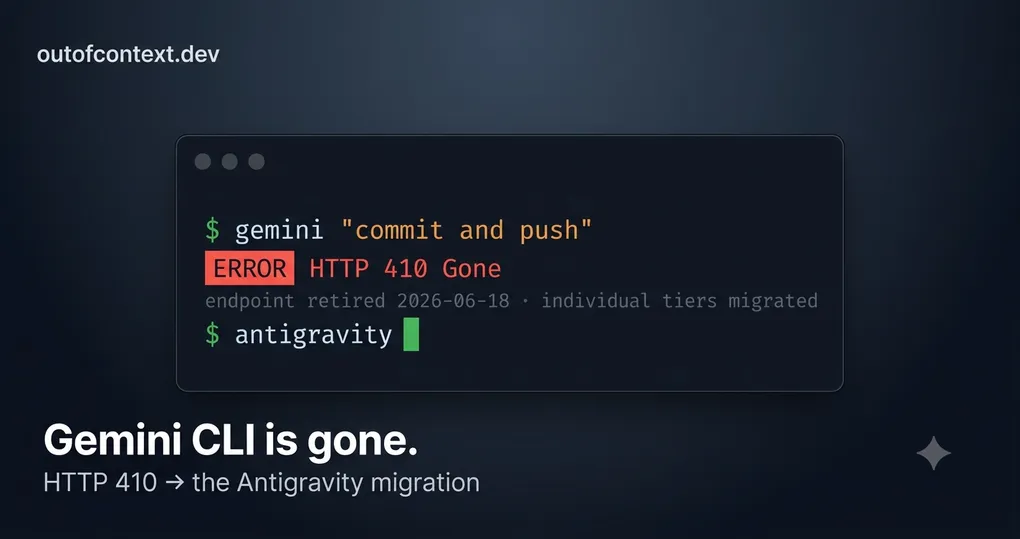
On June 18, 2026, gemini stopped answering.
Not deprecated-with-a-warning. Not a slow sunset. If you were on the free tier, Google AI Pro, or Google AI Ultra, the auth endpoint flipped to HTTP 410 Gone and every gemini command started erroring out. The binary is still sitting on your disk — it just can’t get a response anymore. This was a forced consolidation, not an opt-in upgrade.
Google announced it at I/O on May 19, 2026, and gave a one-month runway: on June 18 both Gemini CLI and the Gemini Code Assist IDE extensions stopped serving individual-tier requests. No grace period after that date. The replacement is Antigravity CLI, the terminal front-end for Google’s Antigravity agent platform, rebuilt in Go.
Here’s who lost access, what genuinely broke, and the honest “should I care” call — because for a lot of people the choice was already made for them.
What Gemini CLI was
Quick grounding, then we move on. Gemini CLI was a terminal-native coding agent you installed with npm install -g @google/gemini-cli — Node-based, open source, and easy to wire into things. That last part is what matters here. People didn’t just chat with it interactively; they put gemini inside shell scripts, CI steps, and cron jobs. Once a CLI is load-bearing in your automation, its shutdown date is your shutdown date.
What Google actually said
The announcement was specific about scope:
- Announced at Google I/O, May 19, 2026 — part of the push to consolidate Google’s dev tooling under the Antigravity brand.
- Cutoff June 18, 2026: Gemini CLI and the Gemini Code Assist IDE extensions stop serving requests for individual tiers. No grace window.
- Carried over: Agent Skills, Hooks, Subagents, MCP, and Extensions — extensions are now called “Antigravity plugins.” Google’s own caveat: “there won’t be 1:1 feature parity right out of the gate.”
That caveat is the one to hold onto. The concepts survived the move; the exact behavior didn’t, and Google didn’t publish a full gap list. So this is a place to test your own setup rather than trust the press release.
Who’s affected — the ten-second check
The cutoff wasn’t uniform. The same binary is dead for a hobbyist and alive for an enterprise seat.
- Affected (off as of June 18): free Gemini Code Assist for individuals, Google AI Pro, Google AI Ultra.
- Unaffected: organizations on Gemini Code Assist Standard or Enterprise, Code Assist for GitHub through Google Cloud, and anyone authenticating with a paid Gemini API key. For them, the old CLI keeps running.
So the self-check: if you signed in with a personal Google account on a consumer plan, you’re migrating. If you’re on an org license or an API key, you can sit still for now.
What actually broke
Access and auth
The headline breakage: individual-tier accounts hit HTTP 410 Gone at the auth endpoint, so every command fails at the first request — a hard error, not a silent no-op. Enterprise and API-key auth are untouched. There’s no flag or config toggle that brings the old endpoint back; the tier is simply cut off.
Scripts and automation — this is the one that stings
Interactive users saw an error and went looking for the announcement. The people who got hurt were the ones who never typed gemini by hand. Anything invoking it non-interactively broke at once:
- shell scripts and aliases that shell out to
gemini - CI pipeline steps that call it for codegen, review, or commit messages
- cron jobs and scheduled tasks
- git hooks
None of these throw a friendly “please migrate” prompt. They start returning errors, and if the exit code wasn’t being checked, they may fail quietly — a green pipeline doing nothing, or a hook that silently stops firing. If you scripted against gemini, grep your automation for the binary name before you trust any of it.
Install and runtime
Gemini CLI was a Node global package. Antigravity CLI is a Go binary — effectively a rename plus a new install path, and early users report the command is now agy rather than gemini. (Google’s announcement confirms the Go rewrite but doesn’t spell out the command name; treat agy as reported-not-official and confirm it against the live docs.) Practically: any hard-coded gemini call is now a wrong command name on top of a dead endpoint.
What carried over
For most individuals this is closer to a rename than a rewrite. Users on the transition thread report that skills, MCP server configs, and agent profiles import automatically, and existing gemini.md context files keep working. What people flag as missing so far: the real-time quota display and the diff preview before a write. Set that against “no 1:1 parity out of the gate” and the honest read is — the load-bearing pieces moved, some conveniences didn’t, and the gaps are still being patched.
Migrating: mostly a rename
For an individual, the move is small: install Antigravity CLI, re-authenticate, and update anything that hard-codes the old command. Google publishes an official migration guide — follow that for the current binary name, install command, and config specifics rather than trusting a checklist that’ll be stale next week.
Two things worth saying out loud:
- Enterprise can defer. If you’re on a Standard/Enterprise license or an API key, Gemini CLI still works. It’s frozen — no new features — so it’s a waiting room, not a home, but you’re not forced to move today.
- The one real gotcha is your automation. The install is the easy part. The expensive part is every
geministill sitting in a CI file, a cron entry, or a git hook — that’s what fails after you’ve moved on and stopped looking.
What it means
You don’t have to litigate whether Google owed its contributors a longer runway to take the practical lesson: a CLI you script against is a vendor dependency, and a vendor can retire it on a date. The tool that shipped open source and took community pull requests is the one that got frozen; the thing you’re moved to is closed.
If you build automation on top of a vendor CLI, the binary name, the license, and the shutdown policy of that CLI are now part of your risk model — not a footnote. Pin the command, check exit codes, keep a fallback, and know which single date could turn your pipeline red. It’s the same lesson as Anthropic pausing its Agent SDK billing split and treating availability as a regulatory variable: don’t bet a critical path on one vendor’s defaults.